
Financial shares were among the top Sensex gainers along with auto and pharma shares.

Ravi Singhal, vice chairman, GCL Securities Private Limited, explains why there is no need to worry as stock market indices gain higher levels.

'Especially if their investment horizon is over two years.'

Adani Enterprises became the fourth listed company of Gautam Adani Group to cross Rs 4 trillion market capitalisation (market cap), as the stock hit a new high on the BSE in Tuesday's intra-day trade. At 01:24 pm; with Rs 4.04 trillion market cap, Adani Enterprises stood at number 15th position in overall market cap ranking on the BSE, data shows. Adani Transmission is at top of the group companies list, with market cap of Rs 4.48 trillion, followed by Adani Total Gas (Rs 3.96 trillion), and Adani Green Energy (Rs 3.72 trillion).

Persistent capital inflows by domestic institutional investors and retail investors kept the markets in fine nick

Mutual funds (MFs) are lining up distinguished new fund offerings (NFOs) for the next financial year to win over investors after a lukewarm response to product launches in the 2022-23 financial year (FY23). NFOs drew a lukewarm response in FY23 as launches were mostly in the passive debt space, which has a comparatively lower popularity among retail investors. The limited launches in equity space also failed to rake in huge sums due to subdued investor sentiments in a volatile market.

Strong MF investments, stemming of FII outflows and positive earnings in Q3 have helped market, say analysts.

Among the Sensex firms, Bajaj Finance emerged as the biggest gainer by climbing 2.95 per cent. Tata Motors, Bajaj Finserv, IndusInd Bank, Sun Pharma, Mahindra & Mahindra, State Bank of India, Larsen & Toubro, HDFC, HDFC Bank, Maruti, Reliance Industries and Bharti Airtel were the other major winners. HCL Technologies, Axis Bank, ICICI Bank, Tech Mahindra and Titan were among the laggards.

The benchmark Nifty rallied 1,000 points or 17% from 7,000 in 78 trading sessions since May 12, till date to surpass the 8,000 mark.

SBI had a bad day, sliding the most by 5.36%. Others that dragged the key indices down were M&M, Reliance Industries and L&T.

A strong performance by sectors including banking raised the profits of Indian companies by 28 per cent in the three months ended March 2022. The rate of growth is, however, lower than the 30 per cent seen in December. Growth in net sales was also lower than what was seen in the December quarter for the sample under consideration.

The Securities and Exchange Board of India is all set to begin the proposed peer audit review of the companies that form the Sensex and Nifty benchmark indices.

Foreign Portfolio Investors (FPIs) pumped in Rs 43,838 crore in Indian equities in May, the highest level in nine months, supported by strong macroeconomic fundamentals, and reasonable valuations. FPIs continued the buying stance in June too, and invested Rs 6,490 crore in just two trading sessions of the month, data with the repositories showed. VK Vijayakumar, chief investment strategist at Geojit Financial Services, said that inflow by FPIs will continue in the current month since the latest GDP data and high-frequency indicators reflect a robust economy gaining further strength.

If a 5% to 10% fall in the equity market gives you sleepless nights, you are not cut out for a 75% to 80% allocation to equities and must reduce it.

The sharp rally in the broader markets has propelled India's market capitalisation (m-cap) to a new high. The combined m-cap of all BSE-listed firms rose to Rs 291.9 trillion in intraday trade on Thursday before settling lower at Rs 290.9 trillion. The previous record was on December 14, 2022, at Rs 291.3 trillion.
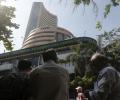
Late selling in blue-chips like Reliance Industries, ITC, Infosys, TCS and Bharti Airtel dragged down the index from the record level to close flat.

'As China's reopening euphoria fizzled out on the back of some disappointing economic data, we saw inflows coming back to India with full force in the past 3-4 months.'

Bajaj Finance's quarterly business update, coupled with around 24 per cent fall over the past six months, has turned risk-reward favourable for investors, observe analysts. They see up to 39 per cent upside in the stock, from a one-year perspective. Global brokerage CLSA, for instance, has upgraded the stock from 'underperform' to 'outperform' with an increased one-year target price of Rs 6,600 (vs Rs 6,000 earlier) as it believes the risk-reward has turned favourable for the counter, and there is scope for expansion if growth remains robust.

The FMCG sector is generally considered to be a safe haven during difficult times as people never stop buying soap and toothpaste. However, weak rural and semi-urban demand has been a factor since the lockdowns of 2020-21 while rising inflation has also impacted margins. While the FMCG majors have survived on the basis of price hikes and good management practices, they have seen growth slowdowns and experienced margins being squeezed as raw materials and transport costs rose. The FMCG sector witnessed positive volume growth in the fourth quarter of the 2022-23 financial year (Q4FY23) after five consecutive quarters of decline, and the rebound in demand was led by urban markets.

India's equity markets are on a roller-coaster ride, after delivering spectacular returns for two consecutive years - in 2020 and 2021. The benchmark National Stock Exchange's (NSE's) Nifty50 is down 1.5 per cent in the first nine months of the current calendar year 2022 (CY22) as foreign portfolio investors sold Indian stocks due to rising bond yields in the US and across global markets, including India. The sell-off in the Indian equity markets has, however, not been broad-based and largely limited to sectors facing earnings headwinds from rising interest rates, lower commodity and energy prices, and likely economic recession in advanced economies.

'I want us not to underestimate Indian voters. They can tell good work from bad.'

Sun Pharma was the best gainer among Sensex components, surging 6.91 per cent

Less-than-expected rainfall and a poor spatial distribution, experts say, can rekindle fears of a rise in food and fuel inflation that can have an impact on the RBI's monetary policy. The fear of less than optimal rainfall due to El Nino this year, analysts believe, is the biggest short-term risk for the markets, which they said has not been fully priced in yet by them. Monsoon set over Kerala on June 08, a week later than its scheduled date.

A recovery in rupee, buying by domestic institutional investors, encouraging earnings by select blue-chips and stock specific buying helped the market get back on its feet

The BSE Midcap and the BSE Smallcap indices pared all intraday gains to end 0.3% and 0.5% lower

Domestic quarterly earnings, global trends and foreign fund trading activity would dictate the movement in equity markets, which may face volatility amid the scheduled monthly derivatives expiry this week, analysts said. Equity markets took a breather last week. The BSE Sensex declined 298.22 points or 0.48 per cent and the Nifty dipped 111.4 points or 0.60 per cent.

'Only if the Budget springs some surprises we may see a halt in the selling.'

Market breadth turned negative with 1,779 declines over 884 advances on the BSE

A widening probe by US authorities involving top drug companies following complaints of price fixing of generics was a point of worry for the participants, said analysts.

A preview of the December quarter's company results by three foreign and three Indian broking houses hints at relatively moderate performance. Of the 47 companies that are part of the BSE Sensex & S&P-CNX Nifty, the benchmark indices, the expected net profit growth is 22 per cent.

IT majors weakened ahead of the September US jobs data and telecom stocks ended lower

The benchmark Sensex is 2.4 per cent shy of a new lifetime high but the market capitalisation (m-cap) of all companies listed on the BSE is already in the record books. At Thursday's (August 18) closing price, the total m-cap of 4,776 firms on the BSE stood at Rs 280.5 trillion, surpassing the previous high of Rs 280 trillion on January 17. This, even if the Nifty Midcap 100 is currently 5.4 per cent below its lifetime high, while the Nifty Smallcap 100 index is down over 20 per cent.

Rise in crude oil price and rally in global equities aided the sentiment

Select metal stocks rebounded while power stocks extended losses after SC verdict on coal block allocations.

Broader market underperformed the headline indices

Despite markets turning volatile, share sale activity at India Inc has surged to its highest level in five months. So far in March, promoters, strategic investors and other large shareholders have been able to offload shares worth more than Rs 33,000 crore-the most since November-defying uncertain market conditions. Both the Sensex and the Nifty are on course to post their fourth straight monthly loss amid headwinds, such as interest rate tightening by the US Federal Reserve and the global banking crisis.

The automobile sector is considered a good indicator of economic health. It has a very long value chain, from primary materials, like metals, glass and plastic, to value-added high-end electronic components, specialised alloys, and software.

In the Sensex kitty, ITC turned star performer by surging 2.45 per cent, followed by NTPC rising 2.19 per cent.

In the broader market, BSE midcap and BSE smallcap indices underperformed the larger counterparts and ended flat with a negative bias.
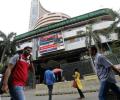
Sensex rises, Nifty holds 8,900; FMCG, Pharma shares lead.
